Automating a Supply Chain Starts With Data, Not Robots
Robotics, AI and optimization engines are the visible face of supply chain automation. They depend on a less visible foundation of identifiers, events, ownership and exception handling, and when that foundation is weak, automation simply accelerates inconsistency.
When leaders picture supply chain automation, they tend to picture machines: autonomous mobile robots moving totes, sortation lines, a planning engine that re-optimizes routes overnight, or an AI assistant that flags delays before anyone asks. These are real and valuable tools. They also share a dependency that is easy to overlook, because it is not visible on the warehouse floor or in a vendor demonstration. Every one of them acts on data, and the quality of the action cannot exceed the quality of what it is fed.
This article sets out what needs to be true about data, events, ownership and exceptions before automation is worth funding. It is written for COOs and heads of supply chain who are being asked to approve robotics or AI initiatives and want a practical way to judge readiness, and for the teams who will build and run what is approved.
Defining the Supply Chain Decision or Movement to Automate Before Choosing Technology
The most common mistake is to begin with the technology question: where can we use AI, or where can we put robots? A better starting point is a specific workflow whose cost, delay or error rate the business already feels. Candidates usually look like one of these:
Allocating inventory to orders;
Scheduling replenishment;
Releasing a warehouse wave;
Planning transport;
Predicting a delay;
Inspecting quality; or
Prioritizing an exception.
For the chosen workflow, describe the current trigger, the inputs, the decision, the action and the person who owns the outcome. Then establish a baseline for time, error rate, rework or service outcome, measured before anything changes. This description often reveals that the decision is made inconsistently by different people, or that its inputs are not available when needed. Those findings are not obstacles to automation. They are the first and most valuable results of the work, because they show what must be fixed for automation to succeed.
Building a Shared Object Model for Products, Locations, Batches, Orders and Shipments
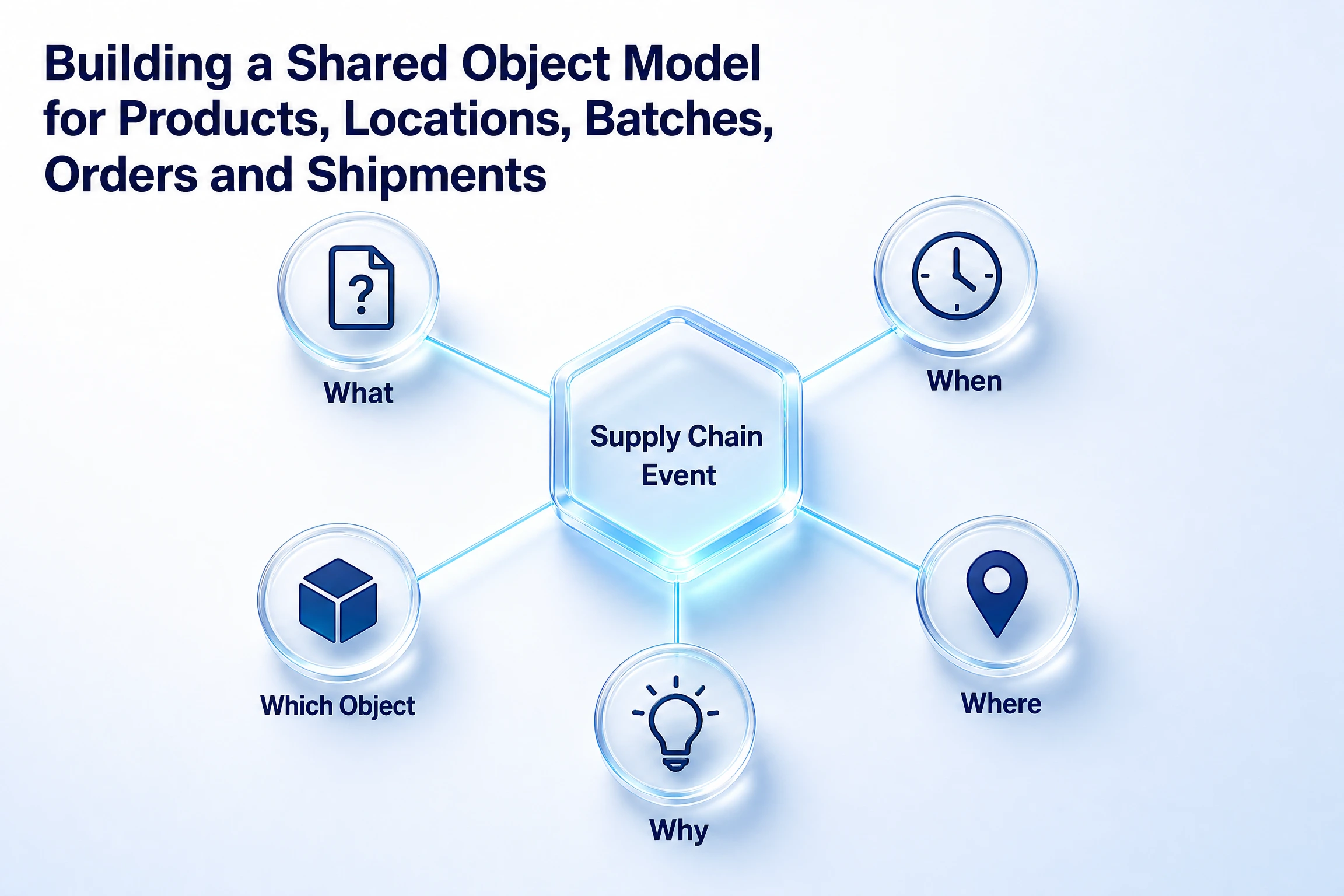
Supply chains cross organizational and system boundaries, and each boundary is a chance for meaning to change. One system's "order" is another's "shipment request," a location code is reused with a different scope in a second site, and a batch is identified by a supplier number in one place and an internal number in another. Automation built on top of these inconsistencies makes fast decisions about things it has not correctly identified.
A shared object model gives teams consistent meanings for products, locations, batches, orders, shipments, assets and events. Industry standards can help. GS1 EPCIS, for instance, provides a common model for visibility events that records what happened, when, where, why and to which business object. An organization does not have to implement the standard end to end to benefit from the discipline it represents. Asking those five questions of every event your systems produce is a practical test of whether the data is ready to drive automated decisions.
Improving Supply Chain Data Quality and Event Timeliness Before Adding Model Complexity
There is a tempting belief that a sufficiently advanced model can compensate for imperfect data. In practice, sophistication tends to hide data problems rather than remove them, and automated decisions spread the consequences faster. A more reliable approach is to assess the event stream itself and to put checks close to the point of ingestion, rather than relying on a monthly report to reveal what went wrong weeks earlier. The table below lists the checks that matter most.
| Data check | Why it matters for automation | Where to test it |
| Identifier consistency | Decisions depend on recognizing the same item, location or order across systems | Compare identifiers across ERP, WMS, TMS and partner feeds |
| Timestamp accuracy and time zones | Sequence and aging logic fail when events are mis-ordered | Sample events across sites, devices and carriers |
| Duplicate or missing events | Automated actions can fire twice or never | Count gaps and repeats per event type |
| Sensor and device calibration | Physical readings drive thresholds and alerts | Compare readings with manual checks on a schedule |
| Master-data ownership | Nobody fixes data that nobody owns | Name an owner and a correction route for each master record |
| Late corrections | Corrections can invalidate decisions already taken | Measure how often records change after use |
| Traceability to source | Reviewers must see where a value came from | Trace a sample of values back to the original event |
| Permission to use the data | Contracts and policies may limit how data can be used | Confirm with the data owner and the relevant internal functions |
None of these checks requires advanced tooling to start. A small team can sample events weekly, measure how many fail each check and track the trend. The trend is also a useful early measure of readiness: when data quality is improving and its owners are visible, the ground is firming up beneath the automation that will stand on it.
Designing the Exception Path as Part of the Automation Product
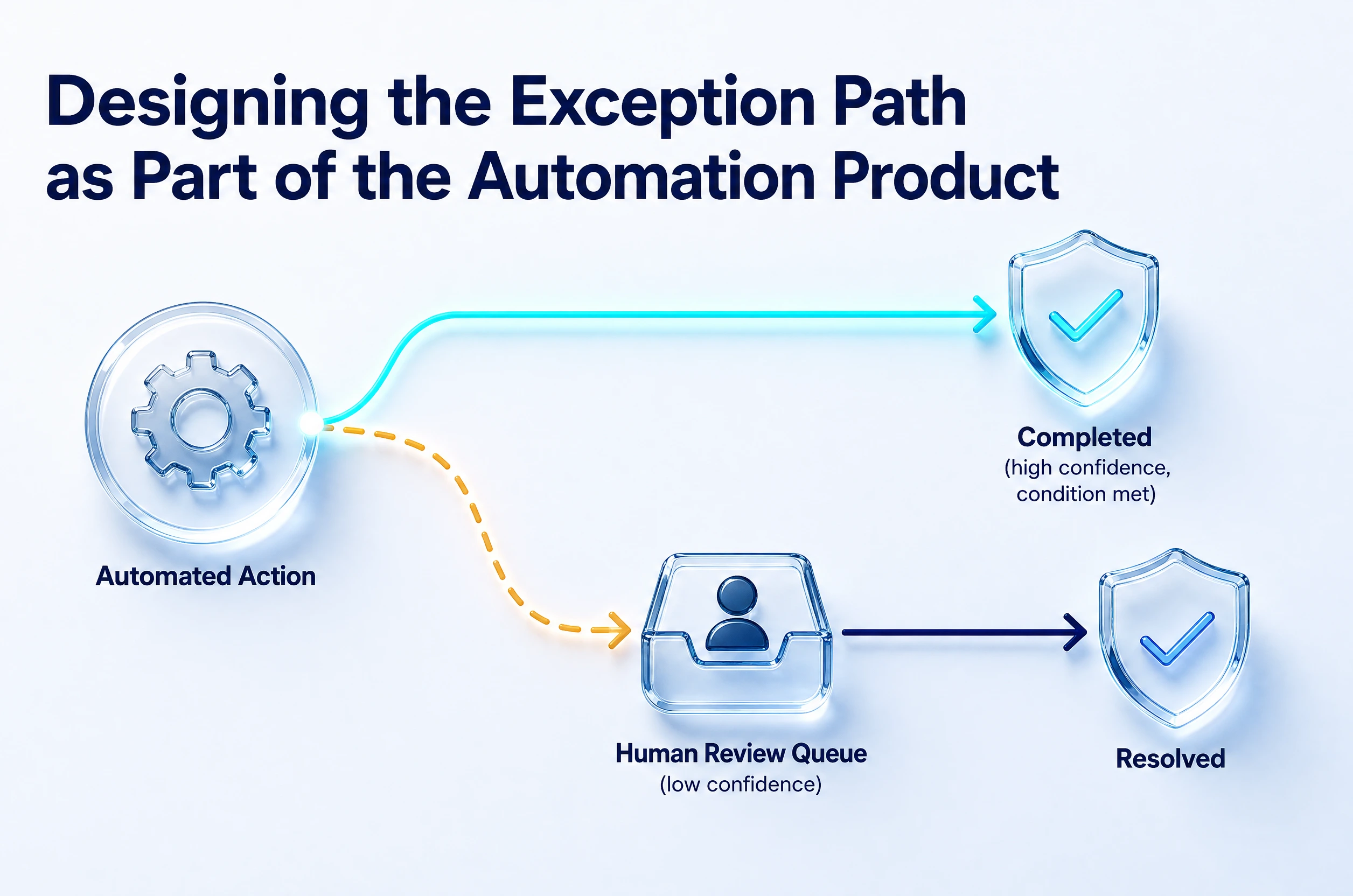
No supply chain is fully predictable. Shipments are delayed, items arrive damaged, orders change mid-flight, and sensors fail. An automated process that cannot recognize its own limits will either stop at the first surprise or push a wrong action through confidently. Neither is acceptable at scale, so automation must know when to stop, when to route to a person and when to ask for a decision.
That behavior has to be designed, not left as a manual patch after launch. For each automated workflow, the exception path should define:
The confidence or validation threshold below which the process stops;
The high-impact exceptions that always go to a person;
The human owner for each type of exception;
The information shown to the reviewer so the decision is fast and informed;
The decision deadline and what happens when it is missed;
The fallback action; and
How the outcome is captured as feedback for improvement.
Human oversight of automated systems is a broader topic in its own right, covered in our earlier piece on AI governance in the system. For supply chain automation specifically, the practical point is that the reviewer's experience is part of the product. If the exception queue is slow, unclear or ignored, the automation is only as reliable as the weakest person-shaped gap in it.
Separating Recommendation From Execution in Supply Chain AI and Optimization
An optimization engine or AI service can recommend a route, an allocation or a priority. A separate, controlled component should decide whether that recommendation is allowed to execute. This separation matters for several reasons:
It makes policy checks and approvals straightforward to apply;
It creates a natural place for audit records; and
It supports rollback when an action turns out to be wrong.
It also makes the system easier to maintain. A model can be replaced, retrained or tuned without giving it direct, uncontrolled access to operational systems, and the rules about what may be executed automatically can be tightened or loosened by the people accountable for the outcome rather than by whoever last updated the model. Over time this lets an organization extend autonomy gradually, as evidence accumulates, instead of granting it all at once.
A Staged Automation Ladder: Observe, Standardize, Assist, Automate Bounded Actions, Optimize
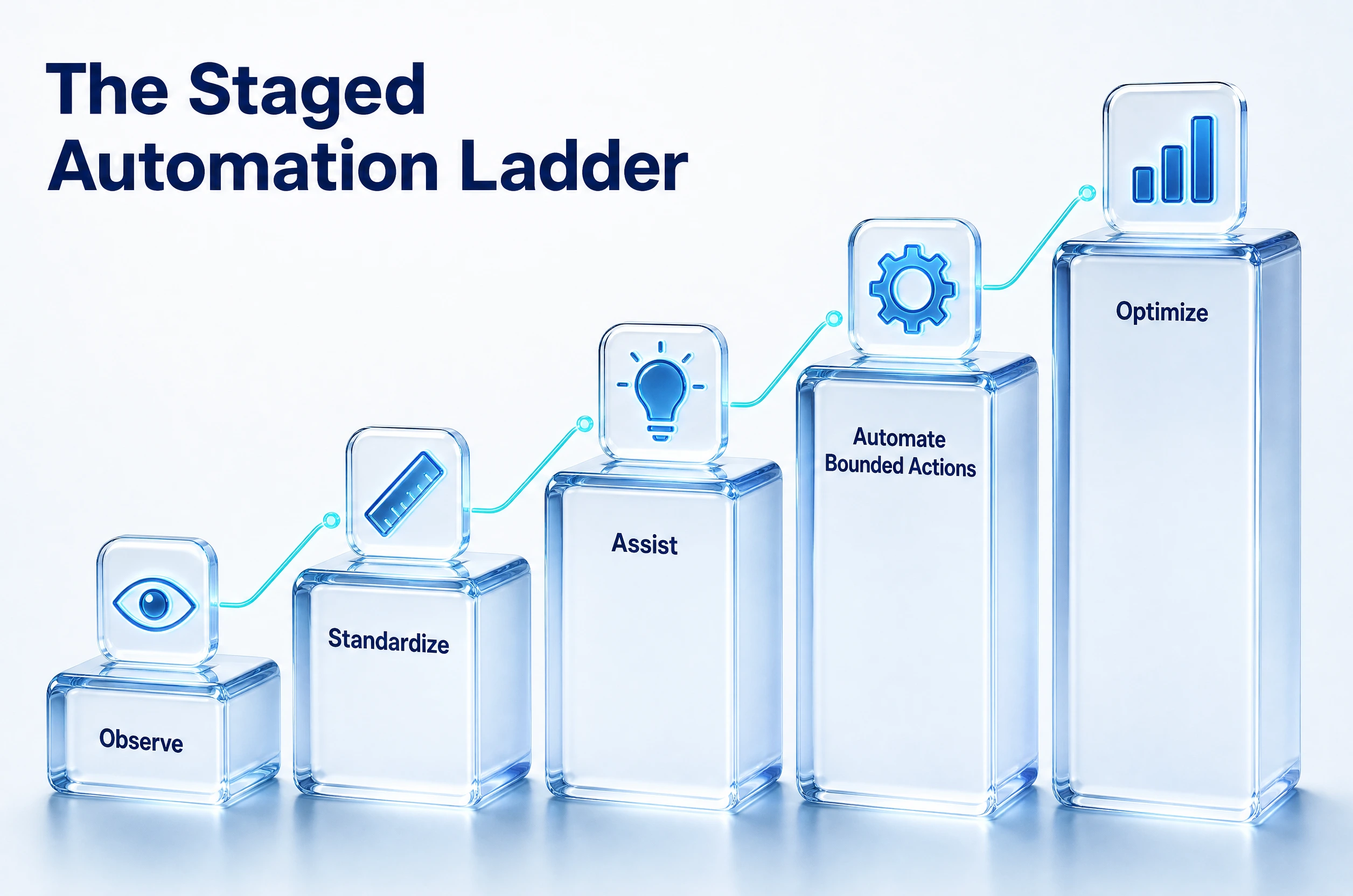
Treating automation as a ladder keeps ambition honest. Each rung produces evidence that justifies the next, and the organization is never asked to trust something it has not seen work.
Observe. Collect reliable events and make the current workflow visible, including its exceptions.
Standardize. Reduce avoidable variation and clarify ownership of decisions and data.
Assist. Provide recommendations or summaries to human operators, who remain responsible for the action.
Automate bounded actions. Execute low-risk, reversible steps within clear limits, with monitoring and a way to stop.
Optimize. Use feedback and operational outcomes to improve decisions over time.
Many supply chains are tempted to jump from observation straight to optimization because the end state is attractive. The skipped rungs are usually where the value is, since standardization and assisted decisions often deliver gains on their own and make the later stages safer. A team that can show a stable, trusted "assist" stage has also built most of what it needs to automate bounded actions responsibly.
Measuring Supply Chain Automation Outcomes Against a Baseline
Metrics should reflect the workflow being automated rather than the technology used. Depending on the process, sensible measures include:
Cycle time;
Exception rate;
Service level;
Inventory discrepancy;
Manual touches per order;
Recovery time after a disruption; and
The quality of decisions compared with a reviewed sample.
Choose a small number, define them precisely and record them before the change.
Claims of improvement are only as good as the baseline behind them. Document the baseline, the measurement period and how changes are attributed to the automation rather than to seasonality, mix or other initiatives. If this is done well, the same evidence supports the decision to move to the next rung of the ladder. If it is skipped, the organization is left debating impressions.
Eight Readiness Questions to Answer Before Funding a Supply Chain Automation Project
The following questions condense the sections above into a quick review that a leadership team can run in a single meeting. A confident yes to most of them suggests the foundation is in place. A cluster of no answers points to where preparation should come first.
Are the workflow, the decision and the owner clearly defined?
Are identifiers consistent across the systems involved?
Are events timely and traceable to their source?
Can the operation keep working with incomplete or late data?
Are automated actions reversible, or at least bounded?
Is the human exception path designed and staffed?
Can the team monitor the automation and stop it quickly?
Is success measured against a documented baseline?
Final Thoughts: The First Automation Win Is Often Making the Problem Visible
Organizations that approach automation as a purchase of robots or models tend to be disappointed, while those that approach it as a discipline of operating data tend to be surprised by how much value arrives before any hardware or model is installed. Simply measuring an exception rate that nobody had counted, or showing two sites the same inconsistency in how they identify a location, often changes behavior and decisions on its own.
A useful test of readiness is whether someone can be named who would be accountable if an automated action were wrong. If that person exists, understands the workflow and can see what the automation did, the organization is ready to take the next step. If not, the most valuable investment is probably in establishing that accountability first. Robots and AI can then amplify a trustworthy operating model, instead of amplifying whatever inconsistency was already there.
GCT Solutions' published AI Consulting, AI Services and Logistics scope covers readiness analysis, data and workflow assessment, warehouse optimization and logistics engineering for clients operating in Hong Kong and across APAC. A first engagement should validate data and operating constraints before an automation approach is selected. To discuss your scope, talk to the GCT Solutions team, and see our AI Consulting, AI Services and Logistics pages.
Frequently Asked Questions About Supply Chain Automation
What is supply chain automation?
It is the use of software, sensors, robotics and analytical or AI services to perform or support supply chain activities with less manual effort, such as allocating inventory, planning transport, releasing warehouse work or flagging exceptions. It ranges from simple rule-based workflow to autonomous equipment, and the right level depends on the maturity of the underlying data and processes.
Where should a company start with supply chain automation?
Start with one specific workflow that has a measurable cost or delay and a clear owner, document how it works today and record a baseline. Then assess whether the data it relies on is consistent, timely and traceable. Technology selection comes after those two steps, not before them.
Do we need AI to automate our supply chain?
Not always. Many valuable improvements come from standardizing workflows, improving data quality and applying clear rules. AI becomes useful where decisions involve patterns or volumes that rules handle poorly, and even then it works best when its recommendations pass through controlled execution and a designed exception path.
How good does supply chain data need to be before automating?
It needs to be good enough that the automation's errors are detectable, bounded and reversible. That generally means consistent identifiers, timely and traceable events, named data owners and checks near ingestion. Perfect data is not required, but the operation must know when data is unreliable and how to respond.
Should robotics come before data work?
Usually the reverse. Physical automation is expensive to change, and it depends on accurate item, location and order data to operate correctly. Establishing reliable events and ownership first lowers the risk that equipment is bought for a process that is not yet stable.
Read Next
What Separates a Warehouse System That Scales From One That Does Not
Everything You Need To Know About Supply Chain Management Software
Sources
GS1: EPCIS visibility standard: https://ref.gs1.org/guidelines/epcis-cbv/2.0.0/
NIST: Smart Manufacturing Systems Design and Analysis: https://www.nist.gov/programs-projects/smart-manufacturing-systems-design-and-analysis-program