Integrating TMS, WMS and ERP Without a Rewrite
Replacing every logistics system at once is rarely necessary and often too risky. A better route is to define who owns what, stabilize the contracts between systems and modernize the highest-friction flow first.
Most logistics operations did not choose their current mix of systems in one decision. The ERP came first, a warehouse management system followed when volumes grew, and a transport management system arrived when routing and carrier management became a function of its own. Each was reasonable when it was bought. Together they now form an estate in which an order crosses three or four boundaries before it is delivered and invoiced, and where small disagreements between systems consume real operational time.
The instinctive response is a replacement program: one platform, one database, one vendor. It is an appealing story and it is often the riskiest option available. This article describes a more controlled alternative for IT managers and solution architects: connect the TMS, WMS and ERP you already run through clear ownership, stable contracts, event flows, reconciliation and phased change, and replace a component only when the evidence says it must go.
Why Replacing Every Logistics System at Once Is Rarely the Right Answer
A full replacement concentrates risk. Every process, interface, report and informal workaround has to be rediscovered, rebuilt and cut over together, usually while the operation keeps shipping. Many of the rules that make a logistics operation work are not in the specification at all. They live in the interfaces, the batch jobs and the habits of the people who know how a late carrier update is handled.
Integration-led modernization takes the opposite stance. It accepts that the existing systems hold valuable behavior, and it focuses on the boundaries between them, because that is where most of the friction occurs. Missing handoffs, duplicate records and conflicting statuses are integration problems far more often than they are product problems. Solving them at the boundary frequently delivers most of the benefit of a replacement at a fraction of the risk, and it keeps the option of replacing a component later, on better evidence.
Assigning a System of Record for Every Core Logistics Object Before Designing Interfaces
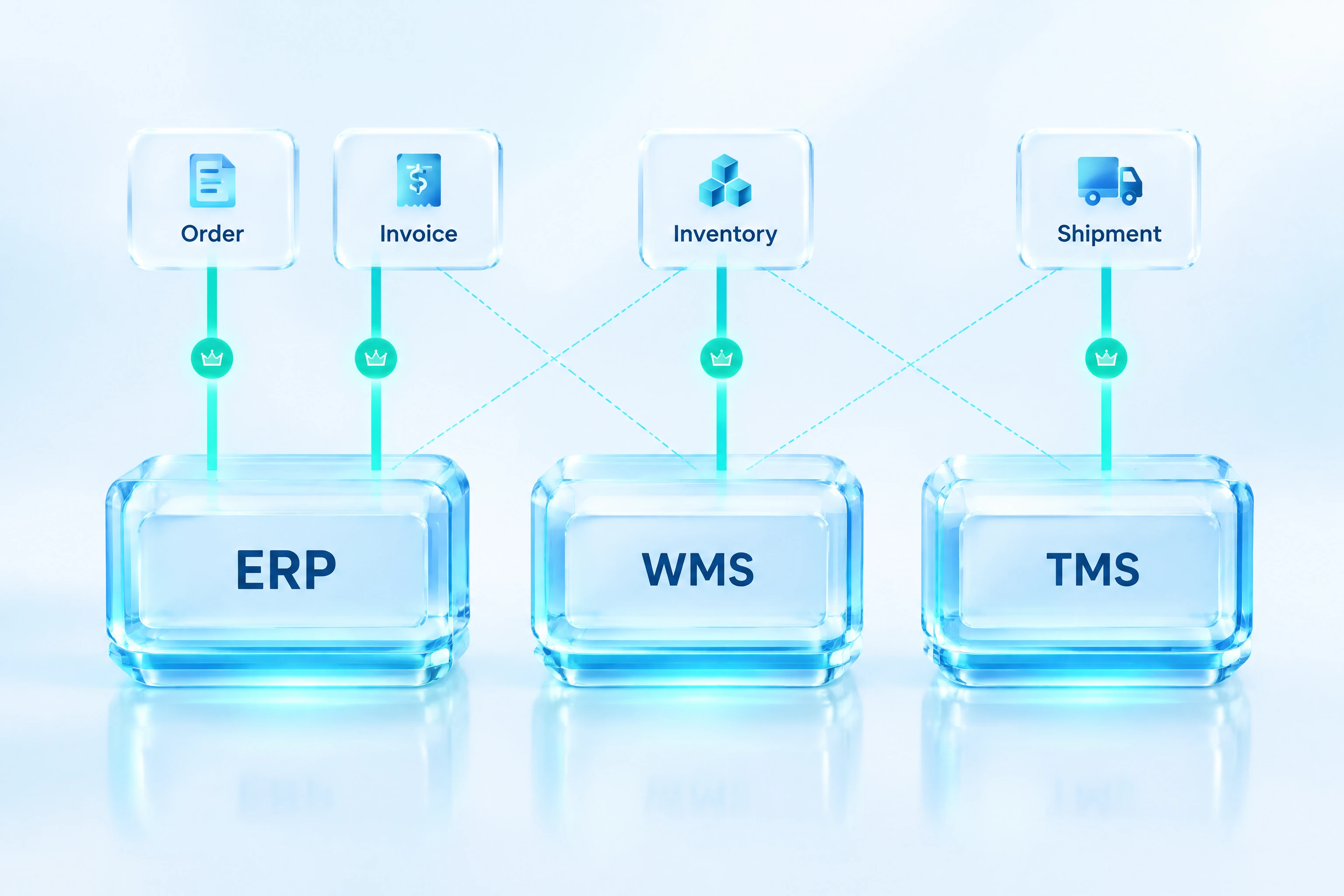
The first design decision is not technical. It is to name, for each core business object, the one system that has authority over it. Where this is left implicit, systems compete silently: the ERP overwrites a quantity the WMS just adjusted, or a carrier status is updated in two places and the last writer wins. The objects that most often need an explicit owner are:
Customer and commercial terms;
Item and location master data;
Order and allocation;
Inventory state;
Shipment and route;
Carrier events; and
Invoice and financial posting.
Systems may share and cache this data, but sharing is different from owning. Once ownership is agreed, every interface can be described in a single direction of authority, and conflicts become rules to enforce instead of arguments to settle during an incident. Ownership also exposes the places where it is genuinely unclear, and those are usually the places where the operation already feels pain.
Mapping One Representative Order From Creation to Financial Reconciliation

System diagrams show connections. They do not show how work actually moves. A more revealing exercise is to follow a single representative order through every stage and mark each handoff, state change, delay and exception along the way. The map below shows the shape of that exercise; in practice it is built with the people who run each stage.
| Stage | Typical handoff to examine | What to mark on the map |
| Order creation | Commerce or customer system to ERP | Validation rules, duplicate orders, who can change the order |
| Availability and allocation | ERP to WMS | Who decides allocation, how shortages and substitutions are communicated |
| Warehouse work | WMS tasks and device events | Partial picks, holds, cancellations during execution |
| Packing and dispatch | WMS to TMS | Weights, handling units, documents, cut-off times |
| Shipment planning | TMS planning and carrier booking | Rate and carrier changes, re-planning after late changes |
| Carrier updates | Carrier to TMS and onward | Event delay, missing or conflicting statuses |
| Delivery outcome | TMS to ERP and customer | Proof of delivery, failed delivery, returns |
| Financial reconciliation | ERP and billing | Freight cost allocation, invoice matching, disputes |
This map usually clarifies the real integration problem more quickly than an architecture drawing. Delays that look like system latency often turn out to be a manual approval step. Duplicates that look like a bug often trace back to two systems each creating a record the other already has.
Choosing Interface Contracts That Define Meaning as Well as Fields
A stable interface is more than a list of field names and types. Two systems can exchange perfectly valid messages and still disagree on what "shipped" means: loaded onto a vehicle, handed to a carrier or scanned at the first hub. The contract should therefore fix the meaning of each object and event, and it should be owned and versioned like any other product. A contract worth relying on documents:
Object and event semantics, including what each status means;
Identifiers and how they map across systems;
Required and optional fields;
Versioning and the deprecation policy;
Ordering and duplicate-handling rules;
Error responses and retry expectations;
Service-level expectations; and
The named owner on each side.
Event models such as GS1 EPCIS illustrate the value of this discipline by describing every event in terms of what happened, when, where, why and to which object. Teams do not need to adopt the standard to borrow the habit. Where it reduces coupling, an adapter or integration layer can translate between systems so that neither needs to know the other's internal model. What should be avoided is placing essential business rules in undocumented scripts between systems, because those scripts become the hardest part of the estate to change or even to find. Good contracts are also easy to test automatically, a practice covered in more depth in the earlier discussion of API testing.
Combining Synchronous Calls, Events and Batch Flows in a Logistics Integration Layer

Not every exchange should work the same way. A synchronous call is appropriate when a user or process needs an immediate answer and cannot continue without it. Events or queues are better when systems can proceed independently and the integration should survive a temporary outage on either side. Batch flows still have a place where the data is naturally periodic and can be reconciled.
A single order illustrates the mix:
An availability check at order entry may need a timely synchronous response;
The "order released" signal from the ERP to the WMS fits naturally as an event;
Carrier status updates arrive asynchronously, whenever the carrier provides them; and
Financial posting may be batched, provided reconciliation shows the batch matched the operational records.
The design work that distinguishes a robust integration is deciding, for each pattern, what happens when it fails: whether the call times out and falls back, whether the event is retried and deduplicated, and whether anyone is alerted when a message is stuck.
Building Reconciliation and Exception Ownership Into the Integration
Distributed systems will disagree occasionally, however carefully they are built. The question is whether the operation finds the disagreement in minutes or discovers it weeks later in a customer complaint or a month-end variance. Reconciliation should be treated as a feature of the solution, designed from the start, rather than as a clean-up task for finance.
A useful reconciliation capability identifies:
Missing records on either side;
Duplicates;
Invalid state transitions;
Stale statuses that have not moved when they should have;
Quantity or amount mismatches; and
Messages that have failed repeatedly.
Detection alone does not help unless every exception has an owner, a priority and a recovery path. A mismatch between shipped quantity and invoiced quantity belongs to someone, has a defined urgency, and has a documented way back to a consistent state. Without that, alerts accumulate and are eventually ignored.
Modernizing in Slices With a Strangler Approach
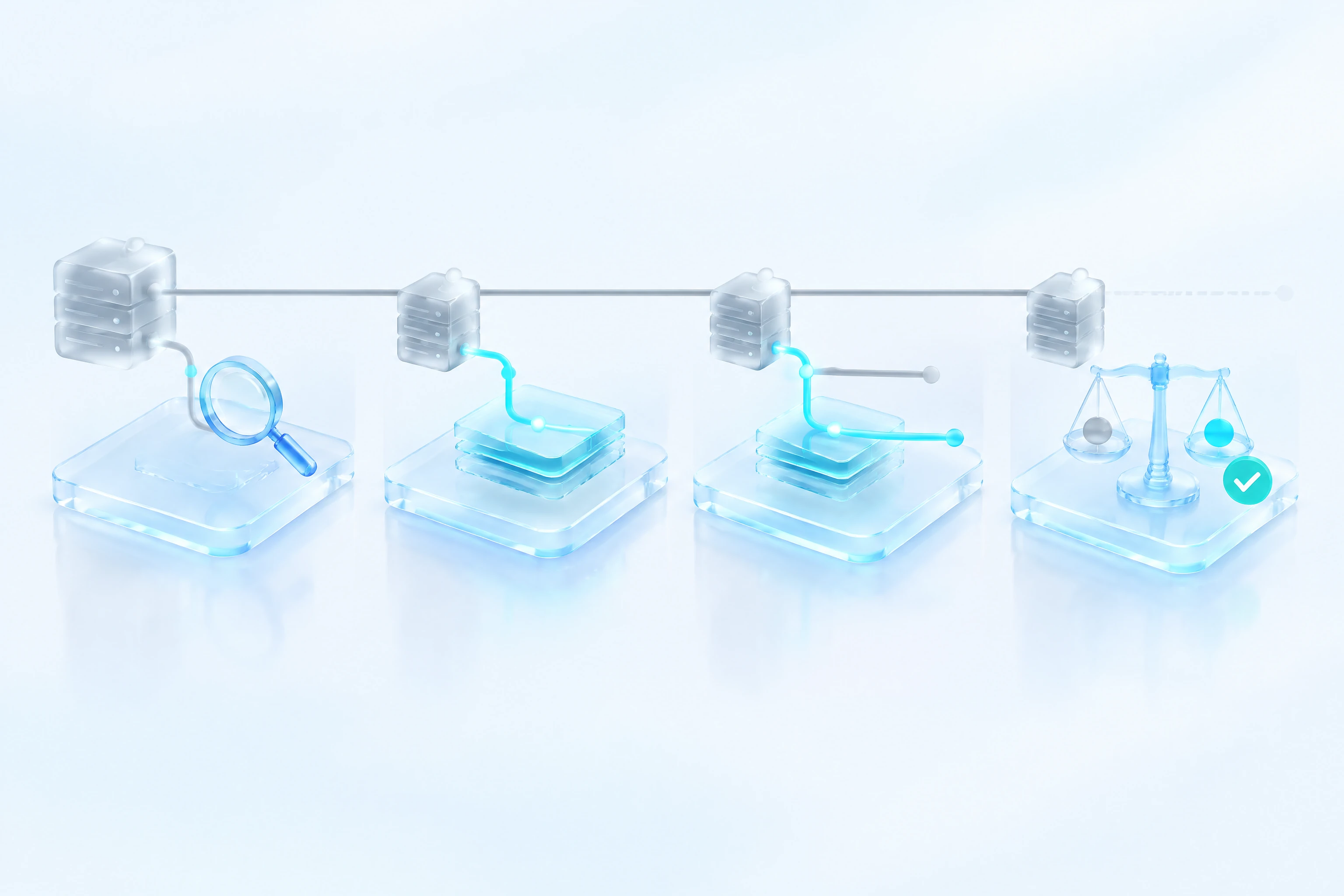
Once ownership, contracts and reconciliation are understood, change can be introduced in slices. The strangler approach, described by Martin Fowler, routes functionality gradually from the old implementation to a new one until the old one can be retired. In a logistics context it usually follows a sequence like this:
Instrument the current interfaces to learn how they behave today.
Document and test the contracts they implicitly follow.
Introduce an adapter or event layer between the systems.
Move one high-value flow, such as carrier status or order release, onto the new path.
Run the old and new paths in parallel where feasible.
Reconcile the results and investigate every difference.
Retire the legacy connection only when the evidence is sufficient.
This reduces the blast radius of any single change, but it does not remove the need for disciplined data and transition management. Parallel running doubles some operational effort, cutover and rollback procedures must be documented, and retirement criteria should be agreed in advance, so the old path does not live on forever because nobody is sure it is safe to switch off.
Testing the Operation as Well as the API
Integration testing that only confirms requests succeed in a test tool will miss the failures that hurt. Real logistics flows include situations that should each be exercised deliberately, with the people who run the process watching the outcome:
Late, duplicated and out-of-order messages;
Partial fulfillment;
Cancellation during execution;
A carrier or device outage; and
Recovery after downtime.
The acceptance criterion is an operation that reaches a known, recoverable state, not a set of green results. If a duplicated shipment confirmation creates a second invoice, the API test passed and the integration failed. Designing tests around these outcomes also gives operations teams a reason to trust the new path, which matters as much as technical correctness when the time comes to switch.
A Decision Checklist for TMS, WMS and ERP Integration Programs
Before committing budget to an integration or modernization program, it is worth confirming that the basics are in place:
Systems of record are agreed;
Business events have unambiguous meanings;
Interfaces are versioned and owned;
Failures are observable;
Reconciliation is designed;
Cutover and rollback are documented;
Users can operate during degraded conditions; and
Retirement criteria for legacy connections are explicit.
Where several of these are missing, the first deliverable should be the missing foundation, not another interface.
Final Thoughts: The Integration You Can Retire Is the One You Can Observe
The most useful early output of an integration program is not new code. It is evidence: a map of how orders actually move, a baseline of how often systems disagree, and a record of which interfaces carry the most operational pain. That evidence turns a vague appetite for a rewrite into a specific, ranked list of flows to improve, and it also shows honestly when a component really does need to be replaced.
Starting this way changes the conversation with the business. Instead of asking for approval of a multi-year replacement, the team proposes a first slice with a measurable outcome and a defined way to stop. That is a much easier decision to make, and a much easier one to be right about.
GCT Solutions' public Logistics and Software Engineering scope includes custom logistics platforms and integrations across distributed operations. An engagement should begin with workflow, ownership and interface discovery rather than a promise to replace the current TMS, WMS or ERP. To discuss your scope, talk to the GCT Solutions team, and see our Software Engineering, Platform Modernization and Logistics pages.
Frequently Asked Questions About TMS, WMS and ERP Integration
Can a company integrate its TMS, WMS and ERP without replacing any of them?
Often yes. If the existing systems are stable enough and can expose data and events through supported interfaces, an adapter or event layer can reduce duplicate entry, conflicting statuses and manual reconciliation without replacing the core platforms. A system should be replaced when it cannot be integrated safely or no longer supports the process, not simply because it is old.
What is a system of record in a logistics integration?
It is the system with authority over a particular business object, such as inventory state or invoice posting. Other systems can read or cache that data, but changes are made in, or approved by, the system of record. Naming it for each object prevents silent conflicts between the TMS, WMS and ERP.
Should logistics systems integrate through APIs, events or batch files?
Usually through a mix. Synchronous APIs suit interactions that need an immediate answer, events and queues suit asynchronous updates such as carrier status, and batch suits periodic data that is reconciled afterward. The choice should follow the business need and the failure behavior you want, not a preference for a single technology.
Do we need an enterprise service bus or middleware product?
Not necessarily. What is needed is a decoupling layer with documented contracts, observability and ownership. That can be a commercial integration platform, a message broker with adapters, or custom services, depending on volume, skills and existing investments. The absence of undocumented logic between systems matters more than the product label.
How do you know when it is safe to retire a legacy interface?
When the new path has run in parallel long enough to show reconciled, matching results across normal and exceptional cases, when rollback is documented, and when the operations owners agree the evidence is sufficient. Define those retirement criteria before the migration begins.
Read Next: What Separates a Warehouse System That Scales From One That Does Not
Sources
GS1: EPCIS visibility data model and interfaces: https://ref.gs1.org/guidelines/epcis-cbv/2.0.0/
NIST: Service-Oriented Architectures for Smart Manufacturing: https://www.nist.gov/programs-projects/service-oriented-architectures-smart-manufacturing-project
Martin Fowler: Strangler Fig Application: https://martinfowler.com/bliki/StranglerFigApplication.html